
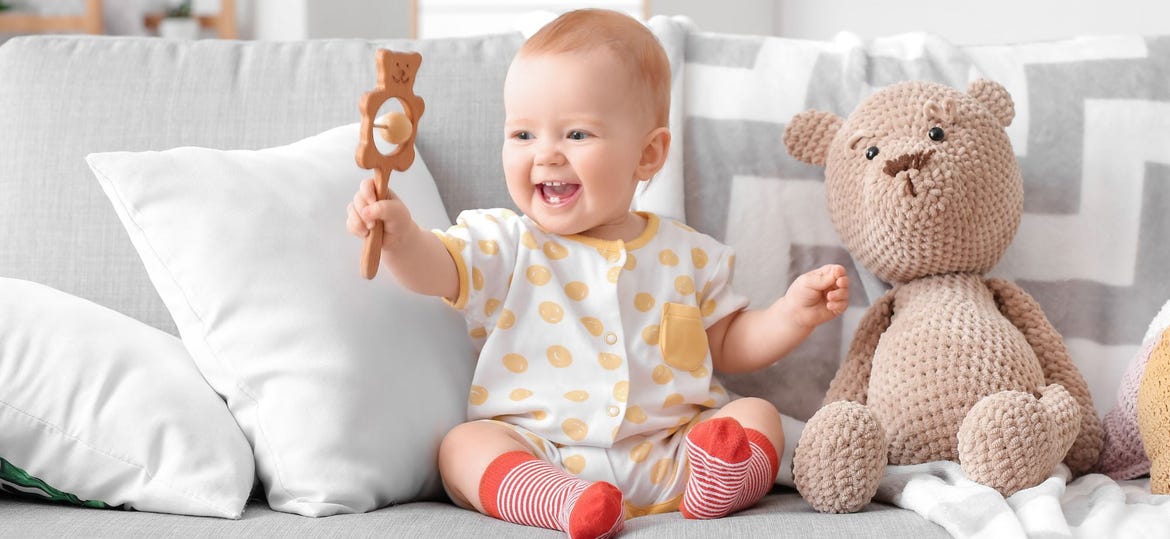
Teething Toys, Rattles & More
Educational toys for babies during their first 6 months
Here’s the revised version, keeping the HTML structure and wording close to the original while improving clarity, consistency and British English usage.
When you’re strolling through the baby departments as parents-to-be, you can quickly get the impression that a baby needs an endless supply of toys, ideally ones that flash, sing and come in bright colours, to ensure they’re stimulated in the best possible way.
In fact, the opposite is true. During the first few months of life, the world is exciting enough for your baby. Their own little hand, Mum and Dad’s faces or a dancing shadow on the wall can be the most exciting toys of all. Just a few carefully selected items are more than enough to gently stimulate your baby’s senses in an age-appropriate way during the first 6 months.
💡 The most important things for the first 6 months at a glance
- Months 1–2 (Sight & Hearing): Newborns’ vision is still blurry. High-contrast images in black and white and gentle music boxes are perfectly sufficient at this stage.
- Months 3–4 (Grasping): Their hands begin to open. Lightweight grasping toys, such as an Oball, and crinkle cloths help develop hand-eye coordination.
- Months 5–6 (Tummy time): To strengthen the neck and back muscles, engaging stimuli such as tumbler toys or a mirror can be helpful.
The golden rule: Less is more. Loud electronic toys can often overstimulate babies.
The first few weeks with your baby (0–2 months)
In the first few weeks after birth, your baby will still be sleeping a great deal. When awake, they can only see clearly at a distance of about 20 to 30 centimetres, which is roughly the distance to your face when breastfeeding or bottle-feeding.
- Contrast books / contrast cards: Babies cannot yet distinguish pastel colours very well. Black-and-white patterns, such as chequered designs or simple faces, can be much easier for them to see. You can simply place small contrast cards next to the changing table.
- Mobiles: A simple mobile above the changing table, rather than above the cot where your baby should be sleeping, helps your baby follow gentle movements with their eyes.
- Music boxes: Gentle sounds can be soothing and help stimulate your baby’s hearing. Some babies may even be familiar with a melody they heard while in the womb.
Discovering the world with their hands (3–4 months)
Around the third month, the innate grasping reflex slowly begins to disappear and your baby starts to hold things deliberately. Everything now finds its way into the mouth, as this is an important way for babies to explore objects and sensations.
- Grasping toys & rattles: They should be lightweight and have a thin handle so that little baby fists can grip them easily. Models made from unvarnished wood or BPA-free silicone are ideal for chewing.
- The Oball: Thanks to its many holes, even very young babies can grasp, shake and throw this ball easily.
- Crinkle cloths: The sound of crinkling fabric can be fascinating for babies and helps them discover the principle of cause and effect: when they press it, it makes a sound.
🛍️ Our favourites for little explorers
In our shop, you’ll find carefully selected, toxin-free toys that gently support your baby’s development without overstimulating them. Browse our categories:
Play & Learn: Discover our toxin-free wooden grasping toys, washable rattles and adorable fabric figures with crinkly sounds for those very first months.
Baby & Child Care: For those tender moments, discover high-quality oils for a gentle baby massage that can help support your baby’s body awareness.
Equipment: Soft play mats and puzzle mats provide a comfortable, non-slip surface for daily exploration on the floor.
Tummy Time (5–6 months)
Tummy time is important for strengthening the neck, back and shoulder muscles, which will later help your baby as they learn to crawl and sit up. However, many babies find being on their tummy quite tiring at first and may protest. The right toys can help motivate them.
- Tumbler toys: If you place a tumbler toy on the floor in front of your baby, they may lift their head to watch it and try to pat it. The jingling sound and rocking motion can provide extra motivation.
- A shatterproof baby mirror: Babies love faces, including their own. A small mirror placed on the floor in front of them can encourage them to spend a little longer on their tummy.
- Water play mats: They provide tactile stimulation for little hands and can also feel pleasantly cool in summer.
👉 Our approach to development: Give your baby time. Lay your child on a blanket on the floor, place one or two toys within reach and simply watch what happens. Babies can often entertain themselves with a simple grasping toy from a very early age when they are given the time and space to explore independently.
Frequently asked questions about a baby’s first toy
Do we absolutely need an activity centre?
It isn’t absolutely essential, but it can be very handy. A simple wooden activity arch encourages babies from around 3 months old to reach upwards and practise their hand-eye coordination. Just make sure you don’t hang up too many toys at once to avoid overstimulating your baby. Often, just two dangling rings are enough.
Are electronic toys with sounds and lights harmful?
For the first few months, simpler toys are often a better choice. Flashing lights and loud sounds can provide a great deal of stimulation at once. A simple wooden toy, on the other hand, encourages your baby to interact with it by grasping, moving or shaking it to produce a sound.
How do I wash and clean baby toys properly?
As babies put almost everything in their mouths, hygiene is important, but toys do not necessarily need to be sterilised.
Wooden toys: Never boil them or put them in the dishwasher. Simply wipe them with a damp cloth, perhaps with a drop of mild washing-up liquid, and leave them to air dry thoroughly.
Fabric and crinkle toys: These can usually be washed at 30 degrees in the washing machine, preferably in a laundry bag. Always follow the manufacturer’s care instructions and use a suitable mild detergent.
Plastic/silicone: Wash with hot water and washing-up liquid. If the product is suitable for boiling, follow the manufacturer’s instructions.
I also corrected a few awkward phrases and inconsistencies, such as “grab toys” to “grasping toys”, while softening several overly absolute developmental claims.
Related products
-

Eichhorn Rattle
- Makes great noises
- FSCⓇ-certified beech wood
- Recommended from 3 months
-
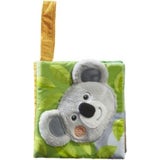
HABA Koala Fabric Book
- Great animal motifs
- Practical Velcro loop
- Educational toy
-
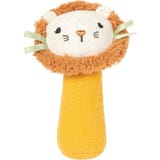
small foot "Little Lion" Fabric Baby Toy Grip with Small Rattle
- Age: 0 months +
- Size: 7.5 x 5 x 12 cm
- Trains grasping reflexes
-
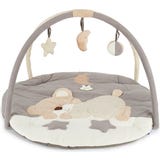
bieco Sleeping Bear Play Mat with Activity Arch Slate
- Removable toys with Velcro
- 3D grasping elements with a rattle
- Easy to carry
Magazine Articles:
Discover Babymondino:
-
Switzerland: Free standard delivery from CHF 69.90
-
Delivery in 3 business days.
Secure payments
with SSL encryption technology